
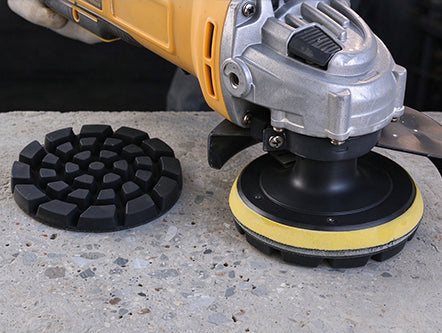
Choosing the right diamond polishing pads can make a significant difference in grinding efficiency, surface smoothness, and final polishing results. However, different materials and applications require different types of polishing pads.
If you are dealing with slow grinding, uneven finishes, excessive pad wear, or poor polishing results, the problem may not be your machine—it may be the wrong polishing pad.
This guide explains the differences between dry diamond polishing pads, wet diamond polishing pads, concrete polishing pads, and 3-step diamond polishing pads, helping you choose the right option for your project.
1. Dry Diamond Polishing Pads: Convenient Stone Polishing
Dry diamond polishing pads are designed for polishing stone surfaces without water. They are a practical choice when water is unavailable or when you want a cleaner and more flexible setup.
A flexible resin design can follow curved edges and surfaces, making these pads suitable for detailed stone work.
Best for:
Granite, Marble, Quartz, Engineered stone, Countertops, Sink edges
A complete grit range such as #50 to #3000 allows you to progress from grinding and smoothing to fine polishing.
Choose dry polishing pads when convenience and flexibility are more important than water-based processing.
2. Wet Diamond Polishing Pads: Stable Polishing with Water
Wet diamond polishing pads are designed to be used with water during grinding and polishing. Water helps control heat and dust, which can provide more stable polishing performance and help extend pad life.
They are commonly used for granite, marble, artificial stone, and other hard stone materials.
Best for:
Granite, Marble, Artificial stone, Other hard stone surfaces
Wet polishing can be a good choice when your workspace allows continuous water use and you want better cooling, dust control, and consistent polishing performance.
Dry vs. Wet Polishing
The choice is not simply about which method is “better.”
Dry polishing: No water required, easier to set up and more convenient for mobile or detailed work.
Wet polishing: Requires water but provides better cooling and dust control, making it suitable for more stable polishing applications.
3. Concrete Polishing Pads: Designed for Concrete Floors
Concrete polishing pads are specifically designed for grinding, polishing, repairing, and renovating concrete surfaces.
Concrete, cement, and terrazzo have different characteristics from natural stone, so using pads designed for concrete can provide more consistent results.
Best for:
Concrete floors, Cement floors, Terrazzo floors, Concrete surface renovation
BRSCHNITT concrete polishing pads are available in grits from #30 to #3000, allowing different stages of grinding and polishing.
A typical progression is:
#30/#50 → #100/#200 → #400/#800 → #1500/#3000
Start with a lower grit for more aggressive grinding, then gradually move to higher grits for a smoother and more polished finish.
4. 3-Step Diamond Polishing Pads: Save Time with Fewer Steps
If traditional polishing requires too many grit changes, 3-step diamond polishing pads can help simplify the process.
The system uses three stages:
Step 1: Coarse Grinding → Step 2: Medium Polishing → Step 3: Fine Polishing
By reducing the number of polishing stages, a 3-step system can help save working time and improve efficiency.
Best for:
Granite, Marble, Quartz, Ceramic, Engineered stone
These pads can support both dry and wet polishing, with wet use recommended when possible for better performance and longer service life.
Choose 3-step polishing pads when reducing polishing time and pad changes is a priority.
5. How to Choose the Right Diamond Polishing Pad Grit?
Grit determines how aggressively the pad removes material and how fine the final surface becomes.
Lower grit = More aggressive grinding
Higher grit = Finer polishing
| Grit Range | Main Purpose |
| #30 / #50 | Heavy grinding and material removal |
| #100 / #200 | Smoothing and scratch refinement |
| #400 / #800 | Further polishing |
| #1500 / #3000 | Fine polishing and finishing |
Do not skip too many grit stages. Each stage should gradually remove the scratches left by the previous one.
The correct starting grit depends on the material, surface condition, and desired finish.
6. Which Diamond Polishing Pad Should You Choose?
| Your Application | Recommended Pad |
| Dry polishing of granite, marble, or quartz | Dry Diamond Polishing Pads |
| Wet polishing of granite or marble | Wet Diamond Polishing Pads |
| Concrete or terrazzo floor grinding | Concrete Polishing Pads |
| Fast stone polishing with fewer steps | 3-Step Diamond Polishing Pads |
Before purchasing, also check the pad diameter, backing system, machine compatibility, and maximum RPM.
Always follow the specifications of the specific polishing pad and do not exceed its maximum operating speed.
Final Thoughts
The right diamond polishing pad depends on your material, polishing method, surface condition, and desired finish.
For granite, marble, quartz, and engineered stone, choose between dry and wet polishing pads based on your working environment. For concrete, cement, and terrazzo, use concrete-specific polishing pads. If you want to reduce polishing stages and improve efficiency, consider a 3-step diamond polishing pad system.
By matching the right pad to the right application, you can improve grinding efficiency, reduce unnecessary pad wear, and achieve a smoother, more consistent finish.