
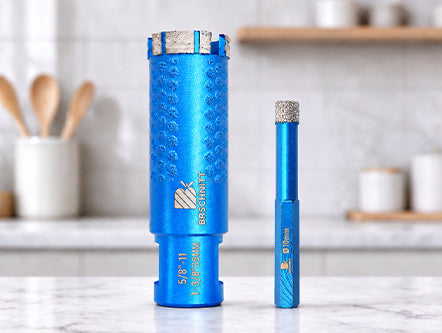
Bei der Wahl von Diamantwerkzeugen für das Bauwesen oder die Steinbearbeitung stehen Bauunternehmer und Fliesenleger oft vor einer entscheidenden Frage: Vakuumgelötet oder lasergeschweißt?
Obwohl beide Technologien hochbelastbare Diamantwerkzeuge hervorbringen, unterscheiden sie sich erheblich in ihren Herstellungsverfahren, ihrer Bindungsfestigkeit und ihren idealen Einsatzbereichen. Die Wahl des falschen Typs kann zu geringen Schnittgeschwindigkeiten, Segmentverlust oder vorzeitigem Klingenverschleiß führen – was Sie wertvolle Zeit und Ihr Werkzeugbudget kostet.
Hier ist eine vollständige Aufschlüsselung, wie diese beiden Verfahren funktionieren und wie Sie das richtige Werkzeug für Ihr Projekt auswählen.
Was sind vakuumgelötete Diamantwerkzeuge?
Vakuumlöten ist ein thermisches Verfahren, bei dem Diamantpartikel in einem Hochtemperatur-Vakuumofen mithilfe einer speziellen Hartlotlegierung direkt auf den Stahlkern des Werkzeugs gebunden werden.
• Hoher Diamantüberstand: Im Gegensatz zu gesinterten Werkzeugen, bei denen Diamanten in einer Metallmatrix eingebettet sind, liegen vakuumgelötete Diamanten zu 70 %–80 % an der Oberfläche frei.
• Scharf & schnell schneidend: Der hohe Überstand sorgt für aggressives, sofortiges Schneiden ohne erforderliche Einlaufzeit.
• Vielseitigkeit: Hervorragend geeignet zum Schneiden und Bohren extrem harter oder aus mehreren Materialien bestehender Untergründe, ohne das Werkzeug wechseln zu müssen.
Beste Anwendungen: Feinsteinzeug, Marmor, Granit, Glas, PVC, Eisen und Mauerwerk. (Häufig verwendet bei Diamant-Bohrkronen, Profilierscheiben und Mörtel-Fräsbits).
Was sind lasergeschweißte Diamantwerkzeuge?
Beim Laserschweißen wird ein hochenergetischer Laserstrahl verwendet, um die Diamantsegmente zu schmelzen und direkt mit dem Stahlkern zu verschmelzen, wodurch eine solide, homogene Stahl-Metall-Schweißnaht entsteht.
• Extreme Hitzebeständigkeit: Die Laserschweißnaht hält intensiver thermischer Belastung stand und verhindert Segmentverlust selbst bei schwerem Trockenschnitt.
• Maximale Sicherheit & Langlebigkeit: Die Bindungsfestigkeit zwischen Segment und Kern ist außergewöhnlich hoch, was das Risiko abfliegender Segmente reduziert.
• Lange Lebensdauer: Entwickelt für tiefe, kontinuierliche Schnitte durch dichtes Baumaterial.
Beste Anwendungen: Schwerbeton, Stahlbeton, Asphalt, Ziegel und harte Steinblöcke. (Häufig verwendet bei großen Diamantsägeblättern und hochbelastbaren Kernbohrkronen).
Vakuumgelötet vs. lasergeschweißt: Vergleich der Merkmale
| Merkmal | Vakuumgelötete Werkzeuge | Lasergeschweißte Werkzeuge |
| Bindungsart | Oberflächen-Diamantbindung | Verschmolzene Segment-Kern-Schweißnaht |
| Diamantüberstand | Sehr hoch (70 %–80 %) | Mittel (allmählicher Matrixverschleiß) |
| Schnittgeschwindigkeit | Schnell & aggressiv | Gleichmäßig & laufruhig |
| Hitzebeständigkeit | Moderat bis hoch | Extrem hoch |
| Hauptvorteil | Ausbruchfreie Schnitte & Vielseitigkeit | Maximale Sicherheit & hohe Langlebigkeit |
| Am besten für | Fliesen, Marmor, Mauerwerk, Mörtel | Beton, Asphalt, Hartgestein |
Welches sollten Sie wählen?
Wählen Sie vakuumgelötete Werkzeuge, wenn:
• Sie Präzisionsschnitte in empfindlichen Materialien (wie Feinsteinzeug oder Marmor) ohne Kantenabsplitterung benötigen.
• Sie Löcher trocken bohren oder Mörtelfugen fräsen, wo Geschwindigkeit und Vielseitigkeit bei verschiedenen Materialien am wichtigsten sind.
Wählen Sie lasergeschweißte Werkzeuge, wenn:
Sie schwere Schnitte durch Stahlbeton, Asphalt oder dichte Pflastersteine durchführen.
Sie maximale Segmenthaftung und thermischen Schutz bei langen, kontinuierlichen Trockenschnitten benötigen.
Wichtigste Erkenntnisse
• Vakuumgelötete Werkzeuge zeichnen sich durch Schärfe, Vielseitigkeit und saubere Oberflächen bei harten Fliesen und Stein aus.
• Lasergeschweißte Werkzeuge legen den Fokus auf extreme Langlebigkeit, Hitzebeständigkeit und Segmentsicherheit bei schweren Baumaterialien.
• Die Anpassung der Werkzeugtechnologie an Ihr spezifisches Material verhindert vorzeitigen Verschleiß, schont Ihre Ausrüstung und senkt die gesamten Projektkosten.