
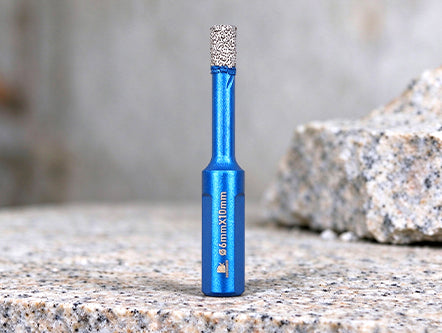
Les trépans diamantés brasés sous vide sont conçus pour offrir rapidité, coupe nette et polyvalence sur des matériaux durs tels que le granit, le marbre, le grès cérame et le béton. Cependant, les surfaces dures et les frottements élevés peuvent rapidement user même les grains de diamant de haute qualité si le trépan n'est pas utilisé correctement.
Pour vous aider à tirer le meilleur parti de vos trépans brasés sous vide BRSCHNITT, voici 5 conseils éprouvés sur le terrain pour prolonger considérablement leur durée de vie.
1. Maîtrisez votre vitesse de rotation et évitez la surchauffe
Les frottements élevés génèrent une chaleur extrême qui dégrade la liaison retenant les particules de diamant sur le corps du trépan.
• Vitesse optimale : Utilisez votre meuleuse d'angle ou votre perceuse dans la plage de régime recommandée (généralement entre 2 000 et 6 000 tr/min selon le diamètre du trépan). Évitez de fonctionner à vitesse maximale sur des pierres extrêmement dures comme le granit.
• Gestion de la chaleur : Une chaleur excessive provoque un glaçage des segments diamantés ou une perte prématurée de leur capacité de coupe. Maintenez une vitesse constante et contrôlée pour réduire l'accumulation de chaleur.
2. Maîtrisez la technique de « l'amorçage incliné »
Démarrer un trou à plat sur une surface dure fait déraper le trépan, provoque des vibrations et ébrèche le bord diamanté avant même qu'il ne pénètre dans le matériau.
• Commencez à un angle de 45° : Placez le bord du trépan contre le matériau à un angle de 45 degrés pour créer une rainure en croissant initiale.
• Redressez lentement : Une fois la rainure amorcée, redressez progressivement l'outil jusqu'à 90 degrés.
• Utilisez un mouvement de balancier : Pendant le perçage, appliquez un léger mouvement orbital ou circulaire. Ce mouvement permet à la poussière de s'évacuer, améliore le refroidissement par air et évite le blocage.
3. Appliquez la bonne pression (laissez les diamants travailler)
Appliquer une force de poussée excessive n'accélère pas le perçage ; cela génère une chaleur excessive et arrache le grain de diamant du noyau en acier.
• Pression légère à modérée : Laissez le tranchant du grain de diamant couper le matériau sous son propre poids et avec un léger guidage manuel.
• Évitez le blocage : Si la perceuse ralentit considérablement ou cale, vous appuyez trop fort. Relâchez immédiatement la pression pour éviter de solliciter inutilement les segments.
4. Éliminez la poussière et refroidissez périodiquement le trépan
L'accumulation de poussière fine de pierre ou de carrelage crée des frottements et colmate la matrice diamantée, ce qui entraîne une surchauffe et une usure rapide.
• Pauses intermittentes : Retirez le trépan du trou toutes les 5 à 10 secondes pendant qu'il tourne pour permettre à l'air d'évacuer la poussière et de refroidir le tranchant.
• Utilisez de l'eau si possible : Bien que les trépans brasés sous vide soient conçus pour le perçage à sec, ajouter un peu d'eau ou utiliser une éponge humide réduit considérablement la poussière, maintient les températures basses et prolonge la durée de vie du trépan.
5. Nettoyez et stockez correctement vos trépans
Un entretien approprié après chaque utilisation garantit que vos trépans seront prêts pour le prochain projet sans perte de performance.
• Éliminez les débris : Nettoyez les carottes et les résidus de matériau à l'intérieur du tube creux après chaque utilisation.
• Affûtez le trépan : Vérifiez si le bord diamanté présente un glaçage. Si le trépan commence à couper lentement, affûtez-le en perçant un court trou dans un matériau abrasif (comme du grès ou un bloc de béton) pour exposer du grain de diamant neuf.
• Stockez au sec : Rangez les trépans dans un endroit propre et sec pour éviter la rouille sur la connexion filetée et le corps du trépan.
Tableau de référence rapide pour l'entretien
| Facteur d'entretien | Bonne pratique | À éviter |
| Technique de perçage | Démarrer à 45°, mouvement orbital léger | Démarrages à plat et pression verticale rigide |
| Pression | Pression modérée et constante | Appuyer fort pour forcer la coupe |
| Refroidissement | Purges d'air intermittentes ou refroidissement humide | Coupe à sec continue sans pauses |
| Stockage | Nettoyé, carotte retirée, environnement sec | Stockage souillé de boue humide ou de poussière |