
Résumé rapide pour les entrepreneurs et les acheteurs :
L'usure rapide des segments d'une meule diamantée est rarement due à un défaut de l'outil ; elle est presque toujours causée par une inadéquation de la dureté du liant.
• Les surfaces souples/abrasives (béton frais, grès) nécessitent une meule frittée à liant dur pour résister à l'érosion par la poussière.
• Les surfaces dures/denses (béton durci, granit, quartz) nécessitent une meule à liant souple ou une meule brasée pour exposer en permanence des diamants frais. Associer la bonne matrice à votre matériau peut doubler la durée de vie de votre outil et réduire les coûts de travail par pied carré jusqu'à 50 %.
Le coût caché de l'usure rapide des outils
Lorsqu'une meule diamantée s'use en quelques minutes au lieu de quelques heures, les dommages vont bien au-delà du prix de remplacement de la meule. Cela entraîne :
• Perte de profit : Budget de consommables gonflé par projet.
• Retards de projet : Les changements fréquents de meules ralentissent la préparation des surfaces.
• Mauvaise finition de surface : Une usure inégale des segments crée des rayures et des profils de surface en béton (CSP) incohérents.
Comprendre pourquoi votre meule boisseau diamantée s'use prématurément est la clé pour réduire vos coûts opérationnels.
Cause principale n° 1 : Inadéquation de la dureté du liant (liant dur vs liant souple)
Les meules à liant dur et à liant souple sont toutes deux des outils diamantés industriels de qualité supérieure. Le terme « liant » fait référence au taux d'usure de la matrice métallique qui maintient les diamants, et non aux diamants eux-mêmes :
• Meules diamantées à liant dur : Dotées d'une matrice métallique dense et résistante à l'usure. Conçues pour les matériaux souples et hautement abrasifs comme le béton frais, la maçonnerie tendre ou le mortier. La matrice dure résiste à la boue abrasive sans libérer les diamants trop rapidement.
• Meules diamantées à liant souple : Dotées d'une matrice conçue pour s'user à un rythme contrôlé. Conçues pour les matériaux durs et denses comme le béton durci à haute résistance (PSI), le granit ou la pierre dure. À mesure que la pierre dure émousse les grains de diamant extérieurs, la matrice souple s'élimine pour exposer de nouvelles couches de diamants tranchants (mécanisme d'auto-affûtage).
La règle d'or : Associez toujours un liant dur aux matériaux souples/abrasifs, et un liant souple aux matériaux durs/denses. Utiliser une meule à liant souple sur du béton frais abrasif détruira le segment en quelques minutes.
Cause principale n° 2 : Utilisation d'une technologie de fabrication inadaptée (frittée vs brasée sous vide)
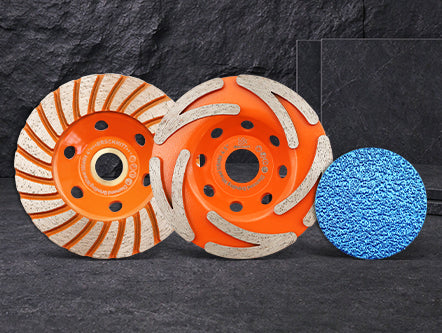
• Meules boisseaux frittées : Construites avec des segments diamantés multicouches. Idéales pour le décapage intensif et le nivellement des sols en béton et en maçonnerie.
• Recommandation : Pour une préparation intensive des sols en béton, utilisez une meule boisseau frittée à double rangée ou une meule diamantée frittée haute efficacité de type Cyclone.
• Disques brasés sous vide : Dotés d'une couche unique de diamants exposés chimiquement liés au support. Idéaux pour une coupe rapide et sans éclat sur les carreaux, le marbre, le Dekton et le verre.
• Erreur à éviter : Tenter de poncer intensivement un sol en béton avec un disque brasé monocouche détruira le revêtement presque instantanément. Utilisez un disque de coupe et de ponçage diamanté brasé dédié, spécifiquement conçu pour les carreaux de porcelaine, le Dekton et le profilage des bords de pierre fine.
Cause principale n° 3 : Erreurs de l'opérateur détruisant les segments
• Pression descendante excessive : Forcer sur la meuleuse d'angle crée une friction intense et un choc thermique. Laissez le poids de la meuleuse et le tranchant des diamants faire le travail.
• Angles de meulage trop prononcés : Maintenir la meuleuse à un angle supérieur à 20° concentre toute la pression sur une fine arête, provoquant une usure rapide et inégale du bord. Maintenez la meule à plat avec un angle faible compris entre 5° et 15°.
• Réglages de tr/min incorrects : Travailler en dessous des tr/min recommandés fait subir aux grains de diamant individuels trop d'impacts par rotation, ce qui fragilise le liant. Adaptez toujours la vitesse de votre meuleuse aux spécifications de la meule (généralement 8 000 à 11 000 tr/min pour les meules de 4,5" à 5").
• Accumulation de chaleur lors du meulage à sec : Un meulage à sec continu sans pauses pour la ventilation entraîne une dégradation thermique. Arrosez avec de l'eau ou faites des pauses périodiques pour refroidir l'outil à l'air libre.
Matrice de dépannage et de sélection pour les entrepreneurs
| Problème / Substrat | Cause principale | Solution immédiate et outil recommandé |
| Meulage béton frais / souple abrasif | La poussière abrasive décape rapidement la matrice souple | Utiliser une meule frittée à liant dur (Meule boisseau frittée double rangée) |
| Meulage béton durci / granit | L'outil se glace, ne coupe plus, surchauffe | Utiliser une meule frittée à liant souple pour une exposition continue des diamants |
| Découpe carreaux porcelaine, Dekton & marbre | Les meules boisseaux standard causent des éclats ou s'usent | Utiliser un disque de ponçage diamanté brasé à grain ultra-fin |
| Usure inégale des bords / rainurage profond | Meuleuse d'angle maintenue à une inclinaison trop forte (>20°) | Réduire l'angle de travail à 5°–15° |
| Étincelles excessives & usure prématurée des segments | Pression trop forte ou mauvais régime de tr/min | Réduire la pression manuelle et vérifier que le régime de la meuleuse correspond aux spécifications de l'outil |